TenTwo Labs

New York/Est. 2026

Open Sumichi

Software · New York

We build AI software for making sense of complex information.

TenTwo Labs takes dense, unstructured material — coursework, scientific literature, experimental data — and gives it a structure you can actually work with. Our first product, Sumichi, is in beta now.

Open Sumichi

Approach

01

Structure, not summary.

Most tools hand back prose about your material. We return the artifacts you work against — outlines, question sets, flashcards, mind maps — because understanding is built on structure, not on more paragraphs to read.

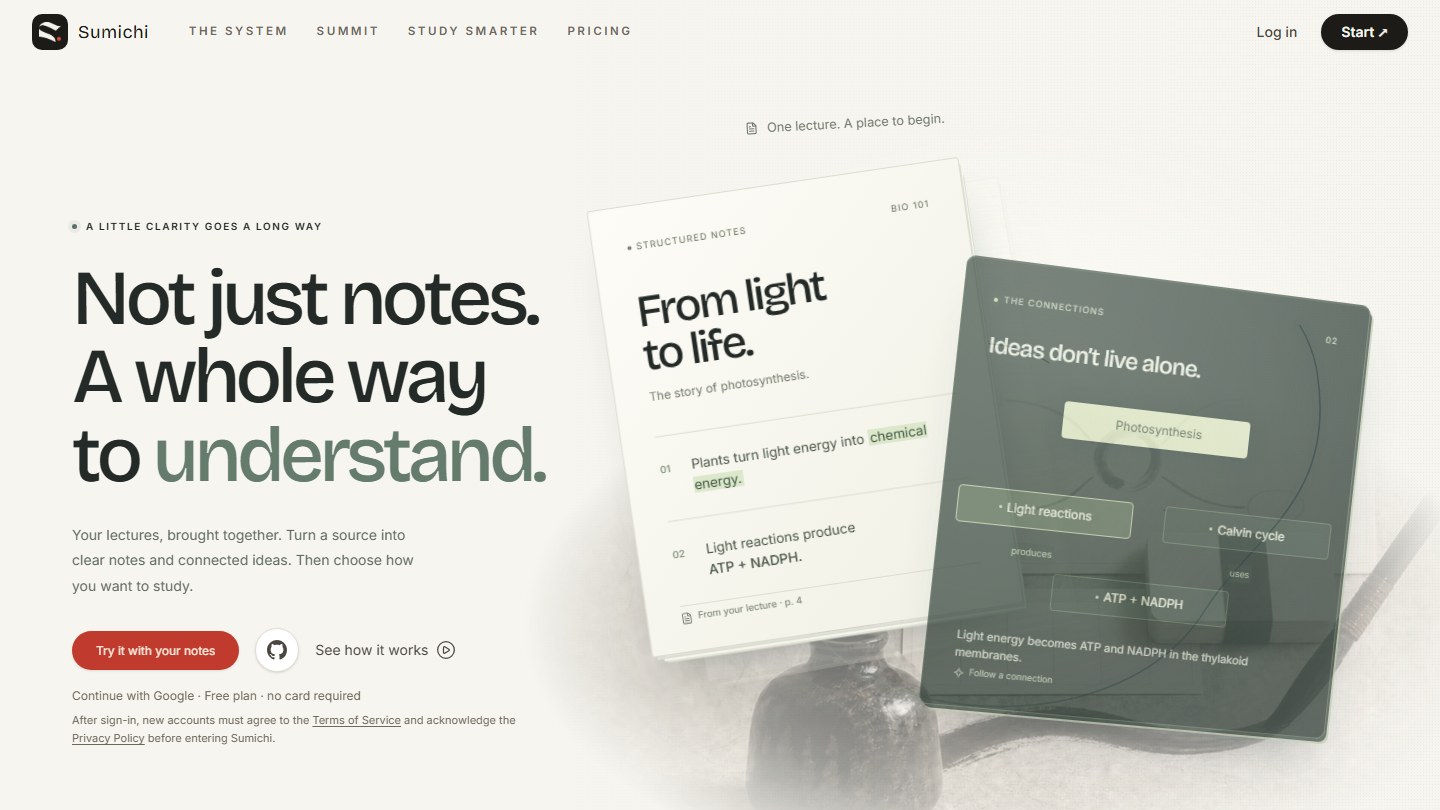
In SumichiOne lecture becomes structured notes, a mind map, flashcards, and quizzes, each linked back to the page it came from.

02

Measure what is actually known.

Correctness alone is a weak signal. We capture confidence alongside it, so the system can separate knowing something from guessing it — and so a learner sees precisely where they are wrong about being right.

In SumichiQuizzes ask how sure you are, so your results separate what you know from what you guessed.

03

Schedule from evidence.

Review timing is computed per item by a spaced-repetition scheduler (FSRS), not set by a fixed calendar. Different material decays at different rates for different people; the schedule should follow the evidence rather than the syllabus.

In SumichiEach card is scheduled on its own, and the study plan works back from your exam date.

Direction

One person’s material is the easy case. The same operation at the scale of a whole field is the interesting one.

Many sources, claims that disagree, and evidence that accumulates until it occasionally overturns what came before.

That is where the work is heading: knowledge held as a structure with lineage rather than a pile of documents, so a claim’s origin, the evidence beneath it, the confidence it warrants, and the way it has shifted over time are all first-class. Nothing to announce yet.

Research

Building on a model you cannot see inside is a guess. We would rather know.

Ongoing work in mechanistic interpretability studies how language models represent information internally, currently attribution graphs in open-weight models.

It is not a side interest. Software that declines to overstate what it knows has to be built by people who understand how these models fail.

Company

Entity
TenTwo Labs LLC
Formed
August 2026
Jurisdiction
New York, USA
Ownership
Founder-owned
Founder
Joseph Lawrence · Managing Member

Contact

jlawrence@tentwolabs.com

For partnerships, press, and grant or program inquiries. Goes directly to Joseph Lawrence, the founder.